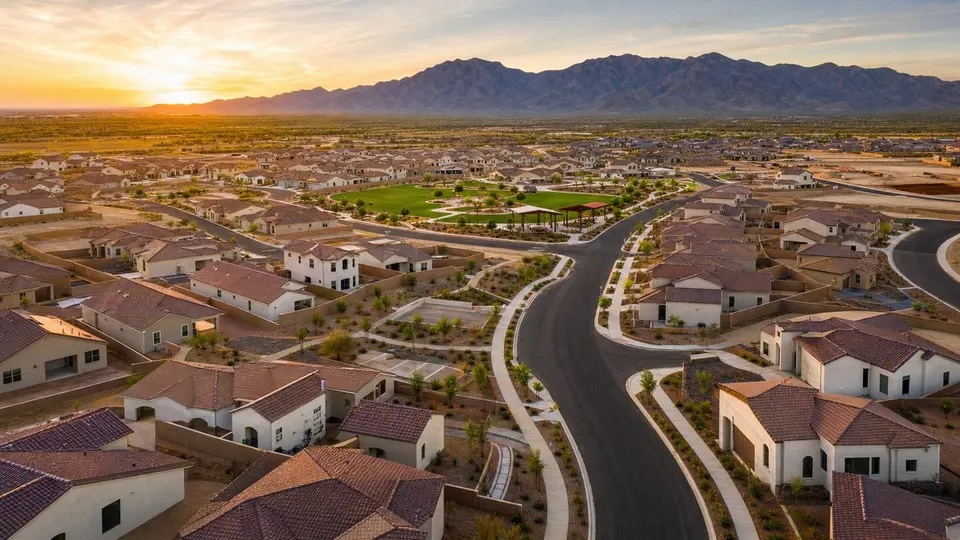
2026 is the biggest new-construction year the West Valley has ever seen. Teravalis just broke ground on 37,000 acres, Verrado Marketplace is opening, and Vistancia's Skymark released 615 homes in April.
2026 is shaping up to be the biggest year for new construction in West Valley Phoenix history — and it isn't close. On November 14, 2025, Howard Hughes Communities cut the ribbon on Teravalis, a 37,000-acre master plan in Buckeye planned for 100,000 homes. Vestar's $275 million Verrado Marketplace starts opening this spring at the entrance to Buckeye's flagship community. And up in Peoria, Vistancia's Skymark at Northpointe released 615 homes in April. Whether you're a first-time buyer looking under $400K or a move-up buyer eyeing a luxury Toll Brothers plan in Sterling Grove, this is the year with the most inventory, the most builder concessions, and the most choice the West Valley has ever offered. Here's the honest breakdown.
Why the West Valley is Arizona's new-construction hub
Three forces made this happen. First, land. The East Valley ran out of large contiguous parcels a decade ago. Buckeye, Surprise, Goodyear, and Peoria still have tens of thousands of developable acres — Teravalis alone is bigger than most Phoenix suburbs. Second, water infrastructure. The communities that pencil today are the ones that secured long-term Assured Water Supply designations before the 2023 Colorado River tightening — which is why Teravalis, Verrado, and Vistancia keep moving while newer speculative subdivisions elsewhere have stalled. Third, jobs and commutes. TSMC's semiconductor investment in north Phoenix, the Loop 303 warehouse and logistics boom, and remote-work migration all point west. Loop 303 now connects Buckeye and Surprise directly to I-17, cutting a trip that used to require I-10 by 15–20 minutes.
The result: people moving to the West Valley in 2026 have more new-build options at more price points than any suburban market in the state. Entry buyers can be in a new D.R. Horton for under $325K in Buckeye. Move-up buyers can pick a Shea Homes view lot in Vistancia. And 55+ buyers have more active-adult new construction to choose from than in any five-year stretch before. For a Surprise-only view, start with new homes in Surprise, AZ.
The five big master-planned communities in 2026
1. Teravalis — Buckeye
Developer: Howard Hughes Communities (the same team behind Summerlin in Las Vegas and Bridgeland in Texas). Size: 37,000 acres — Arizona's largest master-planned community, planned for 100,000 homes and 300,000 residents at build-out. Entry price: low $300,000s, with Meritage plans starting in the mid-$330s.
The first village is Floreo, roughly 3,000 acres and about 10% of the full community. It opened November 2025 with 20 model homes and seven builders: Century Communities, Courtland Communities, DRB Homes, KB Home, Lennar, Meritage Homes, and New Home Co. Sited between the White Tank Mountains and Belmont, Teravalis is set on more than 7,000 acres of preserved open space with conservation corridors and miles of trails already routed. If you want the newest floor plans in the metro at the lowest new-build price points, this is the community to see.
2. Verrado — Buckeye
Developer: DMB Associates. Size: 8,800 acres. Verrado has been the West Valley's flagship master plan for two decades — it's ranked in the RCLCO Top-50 US master-planned communities and logged 312 sales through mid-2025. Entry pricing sits at $350K+ across builders like Taylor Morrison, Beazer, K. Hovnanian, and Tri Pointe.
The big 2026 news: Verrado Marketplace begins opening in May, a 500,000-square-foot, $275 million Vestar development at I-10 and Verrado Way. Anchor tenants include Target (opening May 17), Marshalls and HomeGoods (May 21), plus Ulta, Safeway, Harkins BackLot, Shake Shack, and 50+ more retailers rolling out through early 2027. That transforms Verrado from a beautiful drive-to community into a self-contained live-work-shop town. Combined with its walkable Main Street, 26+ miles of trails, and two golf courses, Verrado is the most amenity-rich option in the West Valley — and prices reflect that.
3. Vistancia — Peoria
Developer: Shea Homes / Sunbelt Holdings. Size: 7,100 acres. Vistancia was already one of the West Valley's most established master plans, and it just doubled down. On April 11, 2026, Skymark at Northpointe launched with 615 planned homes from Shea Homes, David Weekley, and Pulte, priced from the mid-$500Ks to the high-$800Ks. The homes sit at higher elevation than the rest of the community — the marketing tour was literally named "Tour Above It All" — with views of Lake Pleasant and the Bradshaw Mountains.
For a full breakdown of Vistancia's neighborhoods, amenities, and current inventory, see the sibling post: Homes for Sale in Vistancia, AZ.
4. Sterling Grove — Surprise
Developer: Toll Brothers. A gated, all-ages luxury community built around a Jack Nicklaus-designed golf course, Sterling Grove is the West Valley's clearest answer to Scottsdale-style country club living — at Surprise pricing. Expect base pricing from the mid-$600Ks into the low $1Ms depending on collection and lot. Toll's finish quality, semi-custom design center, and 10-year structural warranty are all in play here. Deep-dive: Sterling Grove Homes for Sale.
5. Asante Heritage & new Sun City Grand phases — Surprise
The West Valley's active-adult story keeps expanding. Asante Heritage in north Surprise is layering new construction into an established master plan with resort amenities. Meanwhile, Del Webb continues to release new phases in Sun City Grand and The Grand, and Arizona Traditions remains a value alternative for 55+ buyers who want established amenities without Grand-level HOA fees. For the full picture of what's active, see our guide to 55+ communities in Surprise.
The builders active in the West Valley in 2026
Ten builders write the vast majority of West Valley new-construction contracts. Here's how they line up on price, quality tier, and where they're building, per Ryan Moxley's 2026 Phoenix builder comparison:
- D.R. Horton — $290K to $550K. Entry-volume tier, largest builder in Phoenix by volume. Dominant in Buckeye, Goodyear, Surprise, and Peoria. Fast closes on inventory (30–90 days). Best for first-time buyers and value-per-square-foot shoppers.
- Lennar — $300K to $600K. Entry-mid tier with the "Everything's Included" model — no design-center upgrade grind. Active in Buckeye, Goodyear, Peoria, and Surprise, and one of the seven launch builders at Teravalis.
- Beazer Homes — $310K to $500K. Solid entry-level product in Buckeye and Goodyear. Energy-star focus.
- Meritage Homes — $380K to $700K. Mid-premium tier and best-in-class on energy efficiency (spray foam standard). Dominant in Teravalis and heavily active in Goodyear and Surprise.
- Richmond American — $380K to $650K. Basic standard inclusions — buyers routinely spend $30K–$80K over base at the design center (more on that below). Active in Goodyear and Surprise.
- Mattamy Homes — $400K to $750K. Move-up product with strong architectural detailing.
- Taylor Morrison — $450K to $900K. Mid-premium with tiered, flexible incentives. Most-flexible builder on using outside lenders. Active in Verrado and across the West Valley.
- TRI Pointe — $500K to $1.1M. Premium product, notable in Verrado.
- Shea Homes — $500K to $1.2M. Premium, family-owned, strong warranty follow-through. Dominant at Vistancia/Skymark.
- Toll Brothers — $600K to $2M+. Luxury tier with a semi-custom design center. Sterling Grove is their West Valley flagship.
For a Surprise-specific breakdown, see new home builders in Surprise, AZ.
New construction vs. resale: the tradeoff most West Valley buyers face
Almost every West Valley buyer we work with weighs new build against a lightly-used resale in the same community. Both are legitimate — and the right answer depends on how long you'll own the home and how much control you want over the finishes. The full breakdown lives at new construction vs. resale in Surprise, but here's the short version.
New construction wins on: full builder warranty (10-year structural, 8-year systems, 1-year workmanship on most builders); the newest floor plans; measurably better energy efficiency (a 2026 Meritage will use 30–40% less HVAC than a 2010 comp); rate buydowns and closing-cost credits the builder can offer that a private seller cannot; and the ability to spec finishes to your taste from day one.
Resale wins on: mature landscaping (mesquites and citrus that would take 8–10 years to grow); an HOA that's already funded its reserves rather than one still ramping; blinds, fans, backyards, and refrigerators that don't cost $20K to add after closing; negotiability on price and terms in a buyer's market; and closing in 30 days rather than waiting 5–8 months for a to-build. A one- or two-year-old resale in Vistancia or Verrado often lands 10–15% under what the same home would cost to build fresh once you fully load the design center — that's the arbitrage smart buyers watch for.
The design-center trap
This is the section most builder-adjacent content skips. Sign a $380K base-price Meritage contract and you'll often walk out of the design center at $460K — with the loan underwritten to the higher number. Richmond American buyers routinely spend $30K–$80K over base. Plan for 15–25% over base in total upgrades on a mainstream builder.
What holds value: structural changes (extra garage bay, extended patio, casita, pop-outs), upgraded HVAC and insulation, tile flooring throughout, hard-surface counters, 8-foot doors. What doesn't: designer paint, premium carpet, pendant lighting upgrades, and pre-wired media obsolete in five years. Buy appliances and window coverings from third-party retailers after closing — 30–50% cheaper than the builder. Bring your buyer's agent to the design appointment. Non-negotiable.
How to make a strong offer on new construction in 2026
This is the most buyer-friendly Arizona new-construction market in three years. More than 25% of metro listings have taken a price cut, and builders are sitting on standing inventory they need to move before quarter-end. That's leverage. What to ask for, in rough order of value:
- Rate buydown. Builders spend $15K–$40K per home on permanent or 2-1 buydowns through their in-house lender. A permanent buydown from 6.99% to 4.99% saves $600–$900/month.
- Closing cost credit. $10K–$20K toward closing is standard on inventory homes; ask.
- Free design-center package. On a to-build contract, negotiate flooring or appliances included — often worth $15K–$25K.
- Free backyard landscape. Backyard landscape runs $15K–$30K post-closing. Some builders will include it rather than lose the deal.
Not everything is negotiable at every builder — Lennar's Everything's Included model resists price cuts, for example — but almost every builder in the West Valley will negotiate something in 2026. The buyers getting the best deals aren't the ones asking loudest; they're the ones represented by an agent who knows which builder is behind quarter and which lot has been sitting too long.
Ready to walk through your options?
Damon Ryon has walked many West Valley buyers through builder contracts — from first-time Buckeye buyers signing D.R. Horton addenda to move-up buyers negotiating Toll Brothers structural upgrades at Sterling Grove. He represents you, not the builder — at no cost to you, because the builder pays the commission out of a marketing budget that's already priced into the home. Whether you're comparing Surprise neighborhoods, evaluating single-story new builds, or trying to figure out which Teravalis builder fits your budget, one conversation before your first model-home visit is the difference between paying retail and getting the concessions you're entitled to in this market. Call or text 623-295-8169, or use the contact form to get started. See more Surprise-area coverage and our full real estate library.
Frequently Asked Questions
What's the cheapest new construction in the West Valley?
In 2026, D.R. Horton and Lennar entry-level product in Buckeye starts in the high-$200s to low-$300s, with Teravalis homes beginning in the low-$300,000s and Meritage from the mid-$330s. Beazer's Buckeye plans start around $310K. If you can flex on lot premium, you can be in a new build for under $325K — the lowest true new-construction pricing in the metro.
Where is Teravalis being built and when will it be finished?
Teravalis sits on 37,000 acres in Buckeye between the White Tank Mountains and the Belmont area, west of Verrado. Howard Hughes Communities celebrated its grand opening on November 14, 2025. The first village, Floreo, covers about 3,000 acres — roughly 10% of the full plan. Build-out to the planned 100,000 homes will take decades; expect the first several thousand homes across the mid-to-late 2020s.
Which builder has the best warranty?
Almost every major Phoenix builder now offers the same headline coverage — 10-year structural, 8-year systems, 1-year workmanship, plus each builder's own warranty administration. In practice, Shea Homes and Toll Brothers earn the strongest reputations for actually honoring service tickets after year one. Meritage stands out for energy-efficiency guarantees. Ask each on-site rep for their warranty response time in writing.
Should I use my own agent when buying new construction, or just the on-site sales rep?
Use your own agent. The on-site rep works for the builder and is paid to protect the builder's contract terms, price, and design-center margins. Your buyer's agent represents you at no cost — the builder pays that commission out of a marketing budget that's already priced into the home. Just make sure your agent is registered on your very first visit, or the builder can refuse to recognize the representation later.
How much over base price should I budget for design-center upgrades?
Plan on 15–25% over base for a mainstream builder like Meritage, Taylor Morrison, or Richmond American. On a $380K base contract, that's $57K to $95K in upgrades — most of it flooring, cabinet upgrades, extended patios, and electrical. Richmond American buyers routinely spend $30K–$80K over base at the design center. Structural upgrades (extra bay, pop-out, casita) have to be selected before framing and cost the most.
Is Verrado open to non-golfers?
Yes — golf is one amenity of many. Verrado has 26+ miles of trails, a walkable Main Street, community pools, parks, and — starting spring 2026 — the 500,000-square-foot Verrado Marketplace with Target, Safeway, Harkins BackLot, and Shake Shack. Roughly two-thirds of Verrado residents don't play golf. The community was designed as a walkable town first, not a golf resort.